
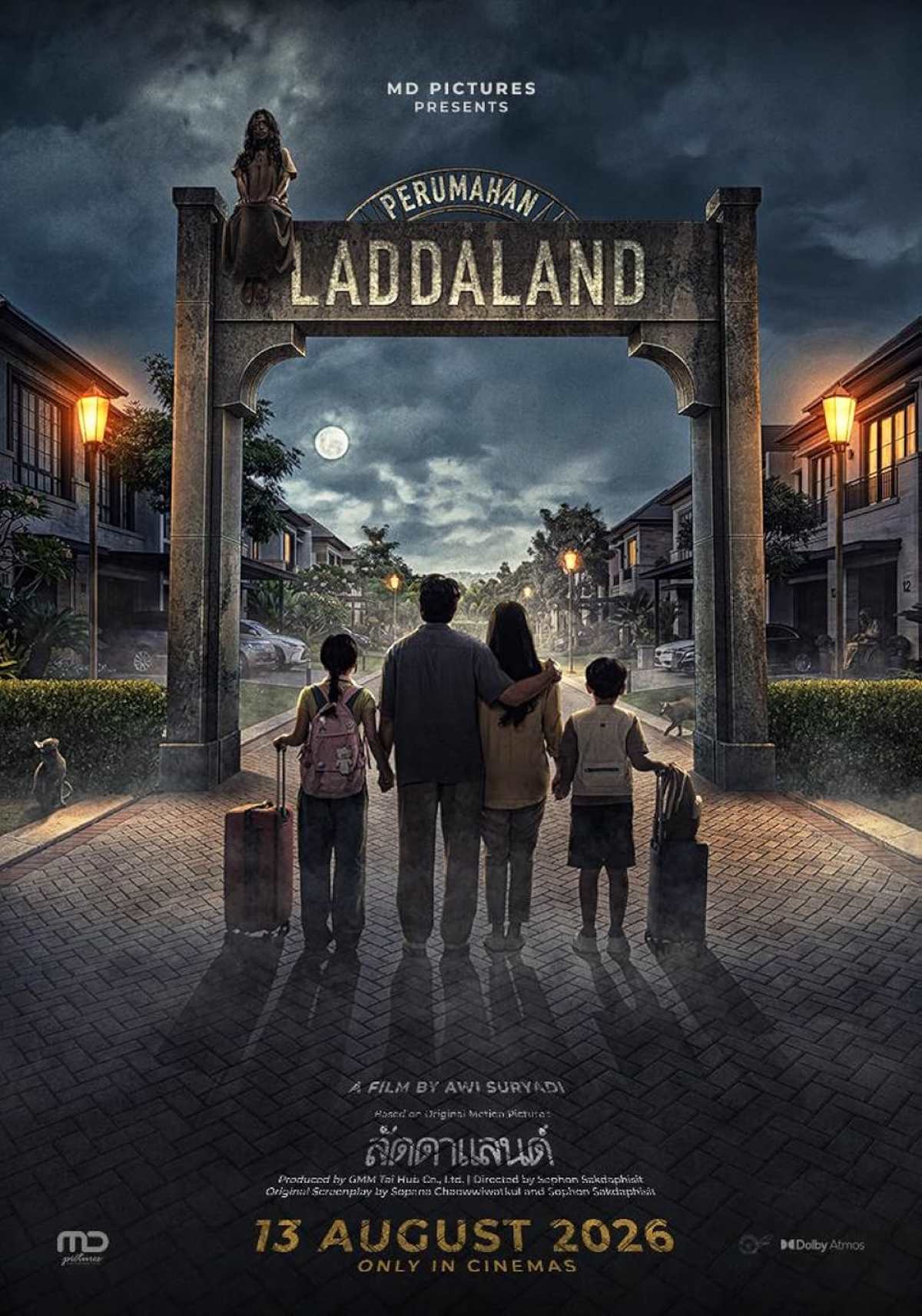
Perumahan Laddaland is an Indonesian remake of the Thai movie Laddaland (2011), but there are a few things going on with the Indonesian version that make it more than a simple copy – directed by Awi Suryadi, written by Lele Laila, and produced by MD Pictures, it moves the story into an Indonesian setting while putting considerably more emphasis on the family drama surrounding the haunting.
The film is scheduled for Indonesian cinemas on 13 August 2026.
Buying the Dream House
Tomy (Andri Mashadi) takes out a mortgage to buy a new home in the supposedly desirable Laddaland housing complex, hoping it will give his wife Melisa (Titi Kamal) and their children a better life, and for a while, everything looks exactly as planned – nice house, comfortable surroundings and the feeling that the family has finally moved into a better situation.
That changes after a series of disturbing incidents begin occurring around the development – there are mysterious whispers, frightening apparitions and increasingly strange events connected to the neighbourhood, while the discovery of a dark secret surrounding the housing complex makes it clear that the family has moved somewhere with a history they know nothing about.
Tomy, however, is reluctant to give up the house. That becomes an important part of the story because the horror is tied to something very recognisable – the pressure of trying to provide a better life for your family while refusing to admit that the dream you have worked for might actually be putting them in danger.
This Isn’t Just a Straight Copy of Laddaland
The original Laddaland was directed by Sophon Sakdaphisit and became one of Thailand’s better-known modern family horror films, so the Indonesian version is officially a remake, but Awi Suryadi has said that he wanted his version to have its own approach rather than simply reproducing the Thai movie.
One of the biggest differences appears to be the emphasis on emotion, as Awi has described Perumahan Laddaland as the saddest horror film he has made, saying that watching the finished film repeatedly made him cry, and that’s a pretty interesting thing for a horror director to say, particularly when the marketing is obviously selling the ghosts and supernatural scares.
So although there is plenty of horror here, the family relationship is clearly not just something sitting underneath the scares, as it seems to be one of the main reasons this adaptation exists in its particular form.
Titi Kamal Has a Slightly Unusual Connection to the Material
Titi Kamal plays Melisa alongside Andri Mashadi, with Anantya Kirana and Shakeel Fauzi Aisy also among the main cast, and the wider cast includes Aufa Assagaf, Laras Sardi, Raffan Al Aryan, Delia Husein, Adjis Doa Ibu and Arief Didu.
There is also a fun little fact about Titi Kamal’s involvement – she has apparently been interested in supposedly haunted places since she was young and talked about going looking for ghosts with friends when she was at school, so she is not exactly coming into a horror production completely unfamiliar with the subject matter.
This is also Titi Kamal’s first big-screen film of 2026, making the project her return to cinemas after previously working across film, television and other entertainment projects.
A House That Looks Perfect From the Outside
Perumahan Laddaland is taking something that is supposed to represent security and success and gradually turns it into the source of the family’s fear, and that contrast is all over the promotional material, and I also like the choice of a modern housing development because it gives the film a very different visual environment from the usual Indonesian haunted-house movie – rows of expensive-looking houses, streets and supposedly safe family spaces can become creepy precisely because they are so ordinary.
The screenplay comes from Lele Laila, who is already a familiar name in Indonesian horror, and she has described the intention as creating fear from something close to everyday life – the home and the surrounding neighbourhood rather than some distant supernatural location.
From Thailand to Indonesia
The original Laddaland was released in 2011 and became particularly well known for combining supernatural horror with family conflict, so the basic premise of moving into a seemingly perfect housing development already works because the house is supposed to represent a new beginning – and then becomes the exact opposite.
The Indonesian remake has the opportunity to retain that core while bringing its own cultural setting, performers and approach to the family relationships, and that is probably the thing I will be watching most closely here: not whether it can reproduce the scares from the Thai film, but whether Awi Suryadi and Lele Laila have managed to make the family’s situation feel sufficiently different to justify another version of the story.
And considering Awi’s comments about the film being his most emotional horror project, it sounds like the remake is putting considerably more weight on the people inside the house than the ghosts outside it.
Trailer
Watch the Perumahan Laddaland trailer on YouTube
Check out some more Indonesian horror movies.









Leave a Reply