
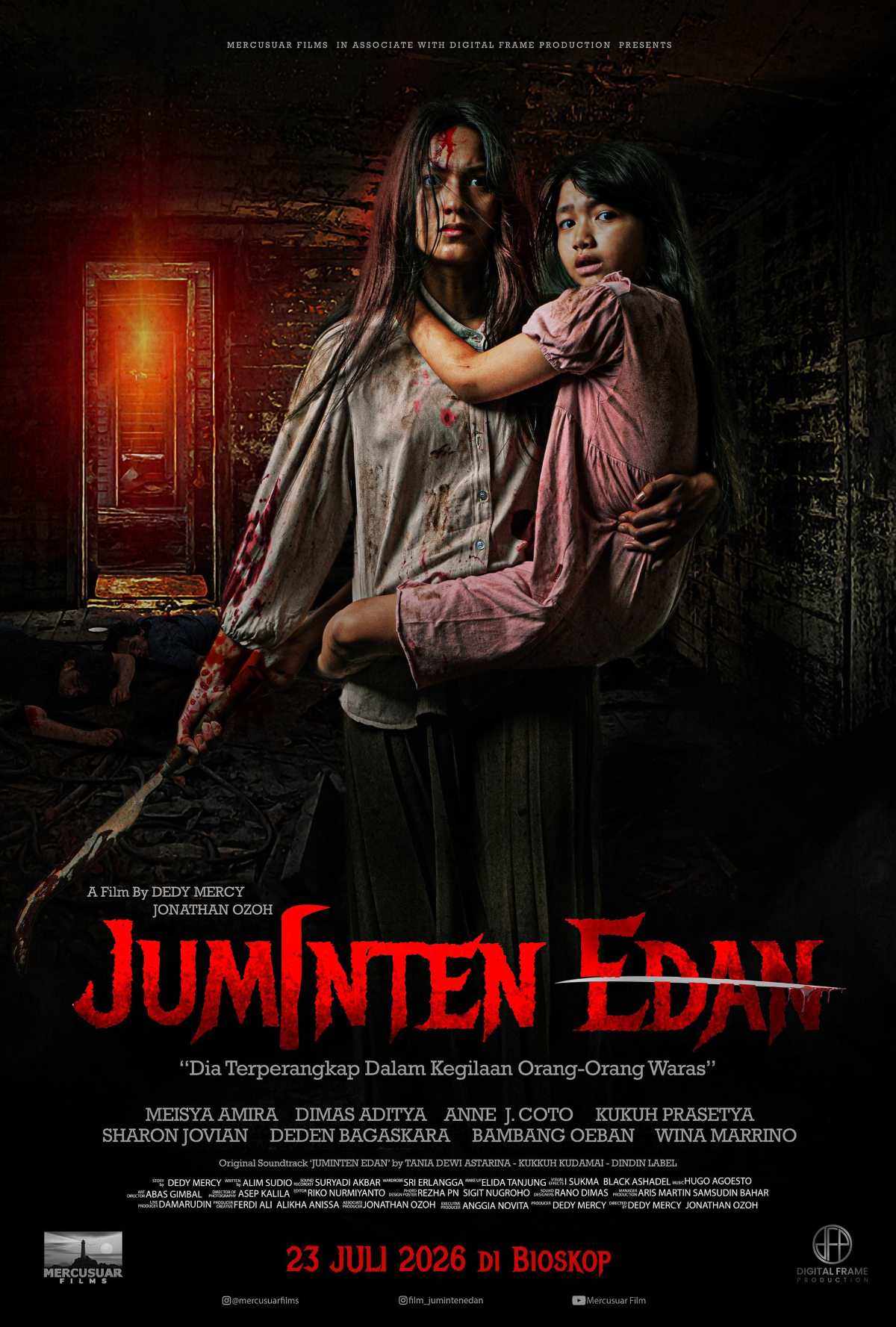
Juminten Edan is a film that looks like it wants to do something a little different from the usual possession movie – it certainly has the supernatural stuff, but underneath it seems we have a deeper story about what happens when a woman is labelled as crazy before anyone bothers to ask what she’s actually going through.
The film was released in Indonesian cinemas on July 23, 2026, runs for 108 minutes, and is directed by Dedy Mercy and Jonathan Ozoh – it’s produced by Mercusuar Films and Digital Frame Production.
Coming Home Doesn’t Go Quite as Planned
After spending eight years away, Juminten (Meisya Amira) returns to the island where she grew up with her husband Manto (Dimas Aditya) and their daughter Saskia (Sharon Jovian), and at first, it’s a family reunion, then things start getting weird.
Juminten begins behaving strangely, sometimes apparently unaware of what she’s doing, and eventually becomes a danger to the people around her, where her behaviour is blamed on a troubled past and possible mental illness, while the possibility of something supernatural becomes harder to ignore.
The situation gets considerably worse when the local community turns against her, and Juminten is eventually restrained and separated from her husband and daughter, with the villagers treating her as a threat rather than somebody who might actually need help.
That’s where the film probably starts getting particularly uncomfortable, because even before the supernatural explanation becomes clear, there’s already something frightening happening – people have decided who Juminten is, and they’re not interested in being proved wrong.
Trailer
Meisya Amira Has a Lot to Carry
Meisya Amira plays Juminten, with Dimas Aditya as Manto and Sharon Jovian as their daughter Saskia – the supporting cast includes Anne J. Coto, Kukuh Prasetya, Deden Bagaskara, Bambang Oeban, Teguh Julianto and Wina Marrino. Feril Ali also appears as the younger Manto, while Maria Lituhayu plays the younger Juminten.
The film’s screenplay is credited to Alim Sudio and Dedy Mercy, with Asep Kalila as cinematographer, Riko Nurmiyanto editing, Abas Gimbal as production designer and Hugo Agoesto handling the music.
I think Meisya here is probably the big question mark for me.
This is a role that depends heavily on expression and physical performance because Juminten has limited ability to communicate verbally. If she doesn’t work, the whole thing is going to struggle, and early Indonesian coverage has actually singled out her performance, particularly the way she conveys fear and desperation without relying on dialogue.
So, that’s a good sign.
There’s a Pretty Grim Piece of Folklore Underneath It
The supernatural side of Juminten Edan is tied to her family history, and one of the darker revelations involves her grandfather, who was a dukun and was killed by villagers after attempting to use Juminten as a sacrifice.
That’s where the film moves away from simply asking whether Juminten is mentally unwell, as we also have a history here that the people living there already know about, and Juminten is caught in the middle of it.
I do like that because Indonesian supernatural horror is at its best for me when the folklore actually affects the characters rather than being something mentioned in passing before the next jump scare.
This One Gets Pretty Physical
The filmmakers have described the film as a mixture of horror, drama and action, and that isn’t just marketing talk – Meisya underwent physical training for the role, while Jonathan Ozoh’s involvement brings a much more physical side to the supernatural conflict.
The film was also shot in locations including Pacitan, Demak and Gunungkidul, with the production using those environments to create the isolated setting, and apparently the idea was partly to bring back the feeling of older Indonesian horror while using modern filmmaking techniques.
I can see why.
There are definitely some old-school ingredients here – remote community, family curse, supernatural disturbance, villagers turning against someone and a horrible secret from the past – but the filmmakers have mixed that with a more modern psychological angle.
Whether all of that fits together smoothly is another question.
The “Mad Woman” Idea
There’s an uncomfortable ambiguity running through Juminten Edan that I think could make it more interesting than the basic synopsis suggests.
People see Juminten behaving violently and decide she’s lost her mind.
That’s understandable to a point.
But the film then asks whether everyone has completely misunderstood what’s happening to her, and that creates a situation where the people trying to control Juminten might actually be making everything worse.
There’s also a irony in the fact that her inability to communicate leaves her with very little chance of explaining herself, which will give the horror a human side before we even get to the supernatural stuff – it’s not particularly subtle, but I don’t think horror always needs to be subtle.
Sometimes watching an entire community decide that somebody is dangerous when they don’t understand her at all can be more uncomfortable than another CGI ghost jumping out of a cupboard.
The Island Has a Lot of History
I also like the decision to put the story on an island rather than simply having Juminten return to an ordinary Indonesian town – she’s coming back to somewhere that already knows her family, so the villagers apparently won’t be looking at her as a complete stranger – they have their own memories, suspicions and stories about what happened in the past.
The setting also gives the film that slightly old-fashioned Indonesian folk-horror feeling I was hoping for – it’s isolated, everyone knows everyone and old stories haven’t disappeared.
It Isn’t Just a Possession Movie
I’ve seen Juminten Edan described as a psychological horror and as a supernatural horror, and I think both descriptions make sense from what I have seen and read, as there are clearly supernatural elements, but the film spends a lot of time with trauma, stigma and the way people react to somebody they don’t understand.
Dedy Mercy has described the film as a kind of miniature version of social problems within a family, with the story deliberately questioning who is actually sane and who gets to decide that, and that’s a pretty heavy idea for a horror film, but I prefer that to pretending the supernatural stuff exists in a vacuum.
And the title Juminten Edan, which basically translates as “Crazy Juminten”, becomes rather uncomfortable when you realise that this is how other people have chosen to define her.
When I first saw the basic premise I did initially think this was going to be another Indonesian possession film with a woman screaming in a dark room for two hours, but I don’t think this is quite that.
There’s certainly plenty of familiar horror material here, but the stuff around Juminten herself is what makes me want to see it, as I’m particularly interested in the way the film handles the question of whether she’s actually possessed, suffering from trauma, or dealing with something that the people around her simply don’t understand.
I also like the fact that the filmmakers haven’t made her a passive victim either, as the physical training and action elements suggest that Juminten gets to fight back, which could make for some pretty good scenes if they pull it off.
I wouldn’t go into this expecting some revolutionary new form of Indonesian horror, as there are plenty of familiar pieces here, but a woman returning to her childhood island after eight years, only to find herself treated as dangerous, while something from her family’s past starts coming back with her is enough to keep me interested.
And after all the horror films where the characters are warned not to open the door and immediately open the damn door anyway, I quite like the idea of one where the real problem is that nobody bothered to listen to the woman who was already telling them something was wrong.
Check out some more Indonesian horror movies.


Leave a Reply