
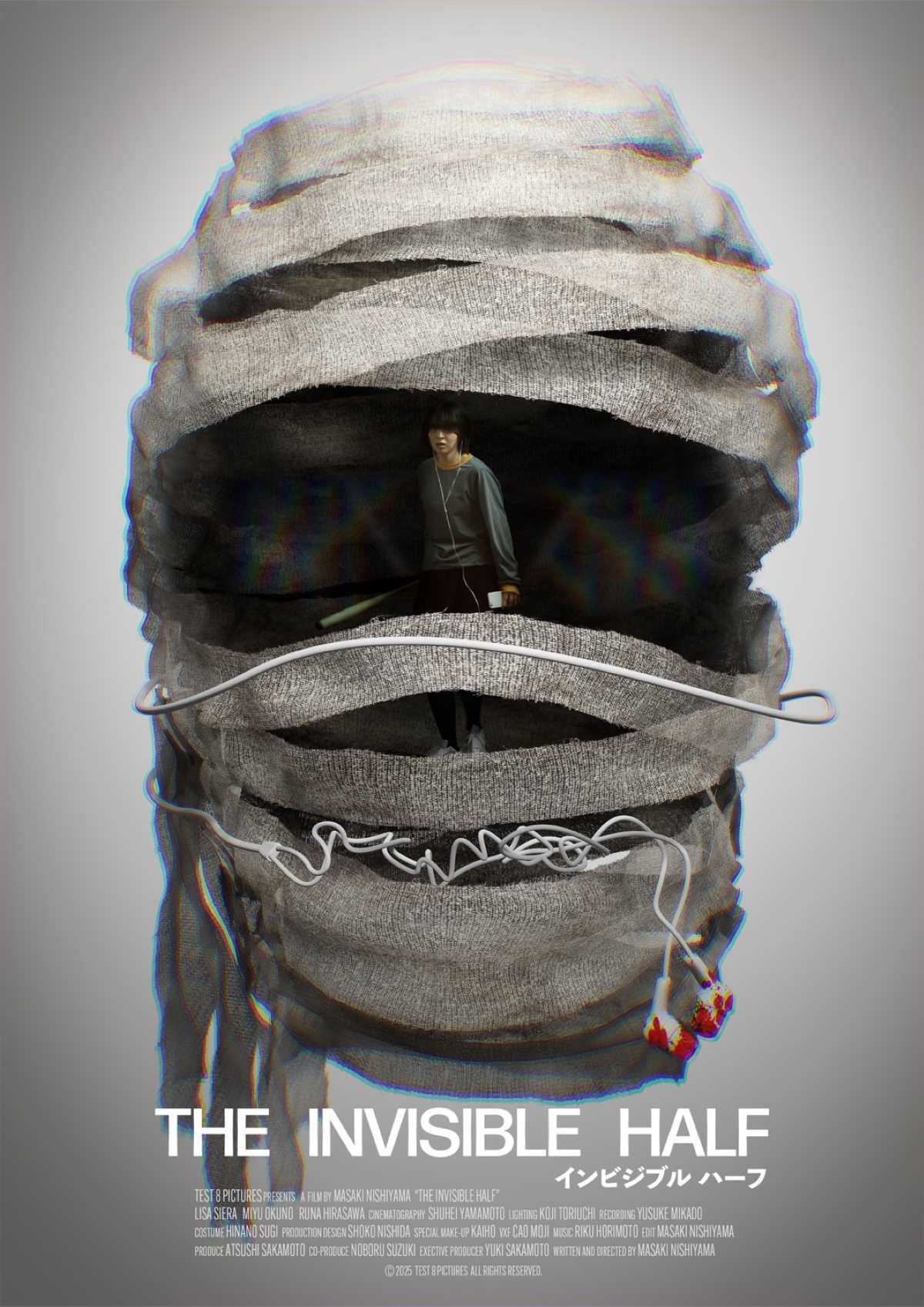
I’ve been seeing The Invisible Half pop up for a while now, and this is one of those Japanese horror films where the basic idea immediately made me want to know more – a girl can see a monster, but nobody else can.
That’s not particularly unusual in horror of course, but there’s a catch here that I really like – she can only see the thing when she’s touching her smartphone, and then she starts hearing it through her earphones.
Yeah, I’d probably throw the phone away at that point.
The film is the feature debut of Masaki Nishiyama, who was just 23 when it was filmed, and it has already picked up attention on the festival circuit, including a nomination for Best International Feature Film at the Raindance Film Festival and three awards at the Tanabe Benkei Film Festival.
Elena Has Enough Problems Already
Elena, played by newcomer Risa Siera, is a mixed-roots Japanese teenager who transfers to a school in a rural town, where she doesn’t exactly have an easy time fitting in, as she’s treated as an outsider because of her appearance and name, and even though Akari, played by Miyu Okuno, is friendly towards her, Elena struggles to let people in.
Then another student, Nyanko, dies.
Nyanko was always attached to her smartphone and earphones, and after her death, strange things begin happening around Elena, before eventually she discovers the creature, except it isn’t just some ghost she can see floating around the school – it’s transparent, and the only time Elena can actually see it is while she’s holding her phone.
The footsteps, meanwhile, come through her earphones, which is a really nice little horror gimmick because it gives the monster a set of rules without immediately explaining what the hell it actually is, and once Elena becomes increasingly dependent on the phone to see what’s following her, the thing that’s supposed to help her understand the threat also becomes part of the problem.
Trailer
Masaki Nishiyama Makes His Feature Debut
Masaki Nishiyama directs, writes and edits the film, with Shuhei Yamamoto serving as director of photography. Riku Horimoto provides the music, while KAIHO handles special-effects makeup and Cao Moji works on the VFX the film was produced by Test 8 Pictures and distributed and promoted in Japan by Geek Pictures.
The main cast includes Risa Siera as Elena, Miyu Okuno as Akari and Runa Hirasawa as Nyanko, alongside Mayu Ozawa, Ayumi, Ami Ishii, Yuri Osawa and Takahiro Sakai, and Nishiyama apparently spent six years developing the project, which is pretty impressive when you remember he was still very young when he actually got around to making it.
I’m always a little more interested in these sorts of independent Japanese horror films than the latest big franchise entry because you can sometimes see somebody trying out an idea simply because they thought it was weird and wanted to see if they could make it work.
This definitely qualifies.
The Horror Is Tied to Elena’s Identity
There is obviously more going on here than girl sees invisible monster through phone – Elena’s status as a mixed-roots Japanese girl is central to the story, and the filmmakers deliberately connect the creature with her feeling of being watched, judged and never quite fitting into the world around her.
That’s where the title starts to make more sense, as she’s being treated as though part of her doesn’t belong, while the creature itself is literally something that other people cannot see.
It’s a fairly obvious metaphor once you know what the film is doing, but I don’t necessarily think that’s a bad thing, because horror has always been good at taking something emotional and giving it a physical form.
And in this case, the invisible thing chasing Elena isn’t just there to provide jump scares.
Phones Are Doing Some Heavy Lifting Here
The smartphone angle is probably my favourite part of the concept, as we’re so used to horror films using phones as a way of getting characters into trouble – strange messages, creepy videos, mysterious calls, that sort of thing – but here, the phone is actually the only reason Elena knows the monster is there.
Take the phone away and she can’t see it, put the phone down and she’s basically blind to the thing hunting her, and then add the earphones, through which she can hear its footsteps, and suddenly this everyday bit of teenage technology becomes almost like a piece of supernatural equipment.
The problem is that she also becomes increasingly unable to let go of it.
That’s a much better use of technology in horror than simply having somebody receive a spooky text message at 2am.
Shot Entirely in Ehime
The film was made with significant support from Ehime Prefecture and Matsuyama City, and the entire movie was shot in Ehime, where it received an advance release in the region on May 15, 2026, before its nationwide Japanese release on July 31 at Human Trust Cinema Shibuya and other cinemas.
That rural setting seems to suit the story too – Elena arrives somewhere new, doesn’t fit in, and then discovers that there is something else around her that doesn’t quite belong either – and I’m not going to pretend I’ve watched it yet, so I can’t tell you whether the metaphor becomes too obvious once the film gets going.
But the Japan Times review was positive about the film’s style and particularly praised Risa Siera’s performance, while describing it as a provocative take on familiar horror ideas.
That makes me more interested rather than less.
There’s a Bit of J-Horror DNA in Here
I can see why people are already comparing The Invisible Half to earlier Japanese horror, as the idea of an apparently ordinary teenager being followed by something that exists just outside normal perception is very much in the J-horror wheelhouse.
But the smartphone rule gives it a more modern identity, and it’s also interesting that the creature is not simply visible through the camera – Elena has to physically hold the phone to see it, which makes the device almost inseparable from her fear.
That gives the film a slightly different flavour from something like Ringu, where technology is basically the delivery system for the curse, as here, technology is both the thing revealing the horror and the thing Elena can’t seem to escape from.
And considering how much time teenagers spend staring at their phones, that’s probably one of the more sensible places to put a modern horror story.
I Think This One Could Be Worth Watching
I’ll be honest, the premise initially sounded like it could go either way – a transparent monster that you can only see through a smartphone is a brilliant idea for a five-minute horror short, but stretching that into 106 minutes is another matter entirely, so that’s the bit I’m curious about.
Fortunately, the festival response and the early Japanese reviews suggest there is more to The Invisible Half than its gimmick, and I also like that the film isn’t pretending the phone is simply a cool horror prop. It’s tied directly into Elena’s life, her isolation and the way she sees herself.
Personally, I’d be much more interested in a film that actually makes something of that idea than one that simply spends 90 minutes showing a monster appearing on a phone screen, and the fact that Nishiyama made this as his feature debut at 23 makes me want to see what he does next.
There are definitely a few familiar pieces here – school horror, social isolation, strange deaths, a mysterious creature – but putting all of them behind a smartphone screen is a pretty clever way of dragging that older J-horror feeling into 2026.
I’m curious about this one.
And yes, after watching it, I suspect I might be looking at my phone slightly differently for a while.
Check out these other Japanese horror movies too.







Leave a Reply